An examination of the implications for upland farmers in Pendle Hill, Lancashire, of a change in agricultural and environmental policy that will replace direct income support with payments for land-based environmental services.

This summary describes a payment scheme designed to provide grants to landowners for planting new woodland in and around the North East Community Forest area. The scheme, commissioned by the North East Community Forest, establishes the best locations to target, and sets payment rates that reflect the public benefits delivered.
This project considers what it would mean to double nature across Northamptonshire and Peterborough and how it could be achieved, and presents this in the form of a Natural Capital Investment Plan. The project began by modelling, mapping and valuing the natural capital assets across the area and identifying key policy drivers influencing decision making. It then determined what it would mean to double nature and calculated the costs and benefits of doing so. It mapped a potential nature recovery network, as well as opportunities to enhance natural capital to meet a range of further objectives. It identified priority areas for targeting these interventions and collated a list of potential natural capital projects being considered across the area. A number of emerging funding mechanisms that could be used to deliver such projects were then identified and described. Six case studies are presented to illustrate the costs and benefits of different types of natural capital projects, and conclusions and recommendations for taking this plan forward are presented.

The project involved a fine-scale and detailed mapping of the natural capital assets, biodiversity and ecosystem services baselines for the open spaces and green infrastructure owned by the City of London Corporation (CoLC).

NCS led a project that explored the development of a tool or set of tools that can quantify and value the health and well-being benefits related to the use of the NHS outdoor estate in Scotland. This included surveys and interviews of key personnel in NHS Scotland to inform an understanding of the taxonomy of uses associated with the NHS outdoor estate; the development of a conceptual logic chain of the relationships between natural capital, activities in greenspace, health and well-being benefits and their value; a targeted rapid literature review of the scientific and grey literature to reveal metrics of health and well-being benefits and the value from activities akin to those that occur on the NHS outdoor estate; and a consultation with academic health economists to discuss the appropriateness and robustness of the valuation methods identified in the review, and how NHS Scotland can best approach the valuation of these benefits across the estate and the data required.
The findings emphasised that there is no quick route to valuing the health and well-being benefits of the NHS outdoor estate in a robust way. There may be some quick wins using benefits transfer from other studies for specific organised health activities where there are known numbers of participants, or from very generic recreational activities in specific habitats (such as walking in woodland). Primary studies using surveys will be necessary to quantify and value health and well-being benefits across a range of NHS outdoor estate activities. The most efficient use of resources would be to prioritise certain activities or user groups and run different projects on pilot NHS Health Board sites. The learning can then be applied to other sites and be used in a future valuation toolkit in the medium to long term.

A project commissioned by RSPB Northern Ireland that explored the added value that enhancing farmland nature can deliver, and assessed its viability in the context of changes to agricultural policy post-Brexit, and the need to address the climate and nature emergencies. The report was delivered as an interactive html file.

A payment scheme designed to provide grants to landowners for planting new woodland in the Forest of Marston Vale area. The scheme, commissioned by the Forest of Marston Vale Trust, establishes the best locations to target and sets payment rates that reflect the public benefits delivered.

An assessment of the potential to create new habitats for the benefit of people and wildlife across Northamptonshire and Peterborough using habitat opportunity mapping.

An assessment of the Blackwater Estuary’s natural capital, the benefits that it provides, and the opportunities to enhance it.

An examination of the interrelationship between natural capital and its economic and social development ambitions for the Cheshire and Warrington area.
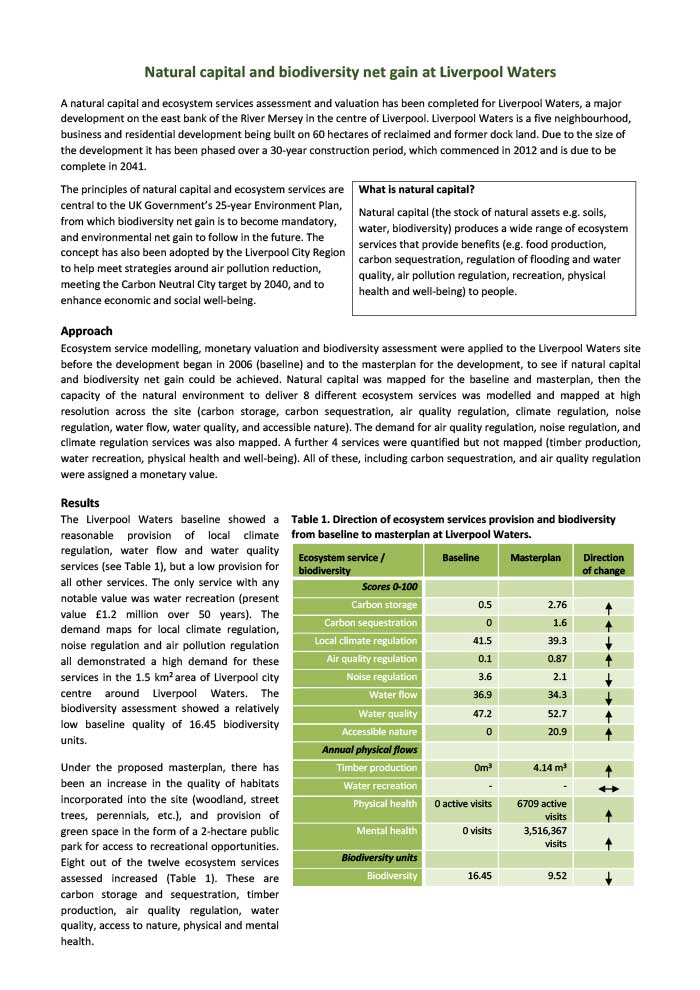
Ecosystem service monitoring, monetary valuation, and biodiversity assessment of the Liverpool Waters site ahead of development to see if natural capital net gain could be achieved.